Cloud Inventory Management Software for Growing Businesses

schedule a demo with Gravity Software
x

See how Gravity compares to leading cloud accounting solutions. Request a demo.

Managing inventory is about much more than tracking quantities. Growing organizations need real-time visibility across multiple legal entities, inventory locations, purchasing, sales orders, assemblies, and financial reporting.

Gravity Software's cloud-based inventory management software helps organizations manage inventory across multiple warehouses, offices, retail locations, and mobile inventory locations from a single cloud platform. Built natively on the Microsoft Power Platform, Gravity provides real-time inventory visibility while integrating seamlessly with purchasing, sales order management, Bill of Materials, financial reporting, and multi-entity accounting.

  • Simplify inventory management across locations
  • Simplify inventory management across locations

    As organizations grow, inventory becomes more difficult to manage across warehouses, retail locations, offices, service vehicles, and multiple legal entities. Finance and operations teams need a clear view of what they have, where it is, what is available, and how inventory activity affects the financial side of the business.

    Gravity Software brings inventory, purchasing, sales orders, assemblies, fulfillment, and financial management together in one system. Teams can monitor inventory quantities and availability, manage inventory across locations and bins, track costs and valuations, process product returns, and maintain a complete transaction history without relying on disconnected inventory systems or spreadsheets.

    For multi-entity organizations, Gravity connects inventory activity with multi-entity accounting, helping teams maintain entity-level control while gaining broader visibility across the organization.

  • Explore Gravity's multi-location inventory capabilities
  • Explore Gravity's multi-location inventory capabilities

    Managing inventory across multiple locations requires more than knowing how many items are in stock. Finance and operations teams need visibility into where inventory is located, what is available, what has already been committed, what is on order, and how inventory movements affect costs and financial reporting.

    Gravity Software connects inventory activity across locations, legal entities, purchasing, sales orders, assemblies, and fulfillment. With real-time inventory data and flexible controls, teams can manage day-to-day operations while maintaining the financial visibility needed to make informed decisions.

    Open boxes representing real-time inventory availability

    Real-time inventory availability

    See more than inventory on hand. Gravity Software provides visibility into inventory quantities, available inventory, items committed to sales orders, inventory on purchase orders, and products moving through fulfillment. Teams can see a more complete picture of inventory availability before making purchasing, sales, and fulfillment decisions.

    Multiple storefronts representing multi-location inventory management

    Multi-location inventory management

    Track inventory across warehouses, retail locations, offices, service vehicles, and other inventory sites from one system. Gravity Software provides location-level visibility into inventory quantities, availability, costs, and activity, helping teams understand what they have and where it is without maintaining separate inventory records for each location.

    For organizations operating multiple legal entities, inventory can be managed at the entity and location level while remaining connected to the same multi-entity accounting platform.

    Warehouse with stored inventory representing bin-level inventory management

    Bin-level inventory management

    Manage inventory within individual bins to gain more detailed visibility into where items are stored within an inventory location. Gravity Software supports bin-to-bin transfers and connects bin information with inventory activity, helping teams maintain more precise inventory records and locate items throughout day-to-day operations.

    Open box with arrows representing inventory transfers

    Inventory transfers

    Move inventory between warehouses, offices, retail locations, service vehicles, and other inventory sites while maintaining accurate quantities and a complete transaction history. Gravity Software records inventory movements as they occur, giving finance and operations teams visibility into where inventory came from, where it moved, and where it is now.

    Inventory tags representing serialized and lot-controlled inventory

    Serialized and lot-controlled inventory

    Track inventory by serial number or lot to improve traceability, accuracy, and visibility throughout the inventory lifecycle. Serial-number tracking can be connected with bin locations, helping teams identify both the individual item and where it is stored.

    Gravity Software maintains detailed inventory records as items move across locations and transactions, while optional lot expiration dates provide additional control for organizations that need to monitor time-sensitive inventory.

    Different-sized inventory packages representing flexible units of measure

    Flexible units of measure

    Buy inventory in one unit, stock it in another, and sell it in a third. Gravity Software supports unit-of-measure conversions that help maintain accurate inventory quantities across purchasing, storage, and sales without requiring manual conversions.

    Dollar sign with gears representing flexible inventory pricing

    Flexible inventory pricing

    Support flexible pricing across customers and inventory items with configurable price classes and item classes. Gravity Software allows organizations to establish pricing by customer and product group, with the flexibility to define more specific pricing when needed.

    Calculator representing inventory costing and valuation

    Inventory costing and valuation

    Maintain accurate inventory costs and valuations with support for Standard, FIFO, LIFO, Weighted Average, and Specific ID costing methods. Gravity Software maintains weighted average costs by inventory site, providing more accurate location-level visibility into inventory value. A weighted average cost adjustment utility gives finance teams additional control when inventory costs need to be adjusted.

    Teams can monitor inventory quantities, costs, and valuations by location while keeping inventory activity connected to the underlying financial records.

    Shopping basket representing purchasing and inventory orders

    Purchasing, sales orders and fulfillment

    Connect inventory with Purchase Order Management and Sales Order Management to maintain visibility from purchasing through customer fulfillment. Teams can see inventory on hand, quantities on purchase orders, inventory committed to sales orders, and what is available to fulfill demand.

    Sales order workflows provide visibility as orders move through picking, shipping, and invoicing, while shipping instructions can flow from the sales order into the picking and shipping process.

    Because purchasing, inventory, sales orders, and financial management share the same system, inventory activity stays connected to the transactions and financial data behind it—reducing duplicate entry and helping finance and operations work from consistent information.

    Inventory components and open box representing assemblies and Bill of Materials

    Assemblies and Bill of Materials

    Connect inventory with Bill of Materials (BOM) to manage assemblies, kits, and bundled products while maintaining visibility into component quantities and costs. As items are assembled, Gravity Software keeps inventory activity connected to the underlying financial records, helping teams maintain accurate inventory quantities, costing, and transaction history.

    Adjustment sliders representing configurable inventory controls

    Configurable inventory controls

    Configure inventory rules to match how your organization operates, including whether to allow backorders or negative inventory. Gravity Software gives teams flexibility to establish appropriate inventory controls while maintaining consistent processes across locations and entities.

    Open box with return arrow representing product returns and RMA management

    Product returns and RMA management

    Manage product returns through a structured return merchandise authorization (RMA) process while keeping returned items connected to inventory and financial activity. Gravity Software helps teams track returned products, process related credits, and return accepted items to inventory with the appropriate inventory cost.

    Inventory report with charts and magnifying glass representing reporting and analysis

    Inventory transaction history, reporting and analysis

    Maintain a complete history of inventory activity, including receipts, sales, transfers, and adjustments, with the ability to drill into the transactions behind inventory movements. Real-time reporting provides visibility into inventory quantities, costs, valuations, availability, and activity across locations, helping finance and operations teams identify trends and make informed decisions.

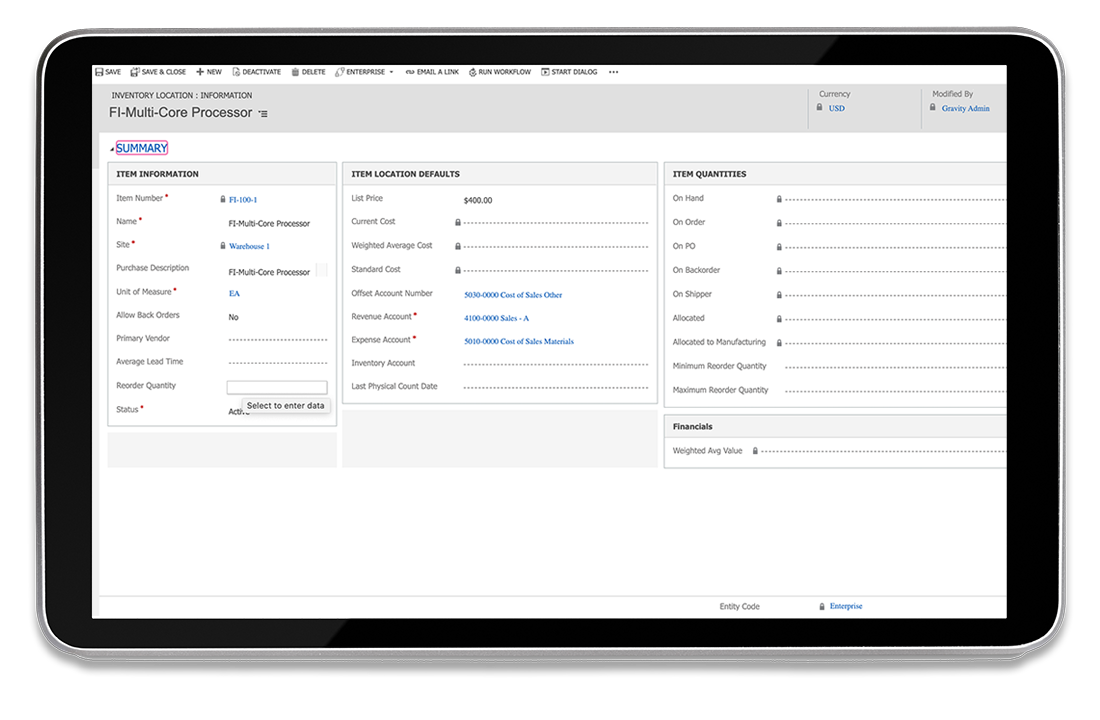
    Inventory screen displaying item numbers and location-specific stock details in Gravity Software.

    See Gravity inventory management in action

    See how Gravity Software helps organizations manage inventory quantities, locations, costing, units of measure, transfers, and transaction history from one cloud-based system.

    Watch the inventory video below to see how finance and operations teams can gain greater visibility and control over inventory across multiple locations while working from a centralized source of financial and operational data.

  • Why choose Gravity Software for inventory management?
  • Why choose Gravity Software for inventory management?

    Inventory decisions affect more than operations. They affect purchasing, sales, cash flow, profitability, and financial reporting. Gravity Software brings inventory and financial management together so growing organizations can manage operational activity without losing visibility into the financial impact.

    Inventory and financials in one system

    Gravity Software connects inventory directly with purchasing, sales orders, assemblies, accounts payable, accounts receivable, and the general ledger. Finance and operations teams work from the same underlying data, reducing duplicate entry and the need to reconcile disconnected inventory and accounting systems.

    Built for multi-entity organizations

    Manage inventory across multiple legal entities and locations while maintaining entity-level financial control. Gravity combines inventory management with multi-entity accounting, helping growing organizations gain broader visibility without managing separate accounting databases for every company.

    Real-time operational and financial visibility

    Inventory transactions update as activity occurs, giving teams current visibility into quantities, availability, costs, valuations, and transaction history. Because inventory and financial data are connected, decision-makers can better understand how operational activity affects the business.

    Connected to the Microsoft ecosystem

    Gravity Software connects inventory and financial management with Microsoft's broader ecosystem for business intelligence, accounting automation, and AI.

    Teams can use Power BI to analyze financial and operational data, Power Automate to automate workflows and approvals, and Microsoft 365 Copilot to securely access authorized Gravity financial information using natural language. Together, these capabilities help finance teams find information faster, automate routine processes, and gain greater insight from their accounting data.

    Built to grow with your business

    Add entities, locations, users, and operational capabilities as your organization grows. From multi-location inventory and bin-level tracking to purchasing, fulfillment, assemblies, and product returns, Gravity Software provides the financial and operational functionality growing businesses need without forcing teams to manage an increasingly complex collection of disconnected systems.


    One system for inventory, operations, and financial management

    Gravity Software connects inventory activity with the financial data behind it, giving finance and operations teams a shared view of the business across entities and locations.

  • Customer success: Dr. Tavel Family Eye Care
  • Customer success: Dr. Tavel Family Eye Care

    Dr. Tavel Family Eye Care operates 24 locations and multiple legal entities. As the organization grew, its legacy accounting system made it increasingly difficult to access financial information, streamline processes, and maintain visibility across the business.

    With Gravity Software, Dr. Tavel moved to a modern, cloud-based financial management platform designed to support a growing multi-entity organization. The team reduced manual work, improved access to real-time information, and gained greater visibility across locations and entities.

    See how Dr. Tavel Family Eye Care modernized multi-entity accounting across 24 locations.

    Real-time visibility across every location

     “Gravity gave us real-time visibility across every location and helped us streamline the way we manage data across our entities. What used to take days is now done in hours—and with far more confidence.”


    — Tera Carpenter, VP of Finance & HR, Dr. Tavel Family Eye Care 


  • Explore inventory and operations resources
  • Explore inventory and operations resources

    G2 'Users Love Us' badge, recognizing Gravity Software for its high customer satisfaction with an average rating of 4.0 stars or higher

    Explore resources on inventory management, purchasing, sales order processing, Bill of Materials, and multi-entity operations to help you evaluate the right approach for your growing organization.

    Inventory Visibility

    Explore how real-time inventory visibility helps growing organizations track quantities, locations, and inventory activity while reducing errors and improving decision-making.

    Managing Inventory Across Multiple Companies

    See how multi-entity organizations can centralize financial management, improve visibility across companies, and better manage operational activity from a single platform.

    Scalable BOM Systems

    Explore how a scalable Bill of Materials system can help growing organizations manage assemblies, component costs, and inventory without the complexity of a traditional ERP.

    Purchase Order Control

    See how purchase order management can improve purchasing visibility, streamline approvals, and provide greater control over purchasing activity as your organization grows.

    Sales Order Automation

    Explore how sales order management can streamline order processing, improve inventory visibility, and help teams manage customer orders through fulfillment.

    Demo Highlights

    Watch this 11-minute overview of Gravity Software's key capabilities, including multi-entity accounting, financial reporting, automation, business intelligence, and operational management.

  • Frequently asked questions
  • Frequently asked questions

    Sales representative symbolizing support and answers to common inventory management questions.

    Have questions about how Gravity Software inventory management supports your business? Here are answers to common questions from growing organizations looking to manage inventory across multiple locations, legal entities, and operational workflows.

    arrow

    Can I manage inventory across multiple companies?

    Yes. Gravity Software enables organizations to manage inventory across multiple legal entities within a single cloud platform while maintaining entity-level inventory visibility, financial control, and reporting. See how Gravity supports multi-entity accounting for growing organizations.

    Can I manage inventory across multiple locations?

    Yes. Gravity Software supports inventory across warehouses, retail locations, offices, service vehicles, and other inventory sites. Teams can monitor inventory quantities and activity by location while maintaining a centralized view across the organization.

    Can Gravity show what inventory is available versus committed?

    Yes. Gravity provides visibility into inventory on hand, available inventory, quantities committed to sales orders, and inventory on purchase orders. This helps purchasing, sales, and operations teams make more informed decisions using current inventory information.

    Does Gravity Software support bin-level inventory management?

    Yes. Gravity Software supports bin-level inventory management, allowing organizations to track where inventory is stored within individual locations. Teams can manage bin-to-bin transfers and connect serial-number tracking with bin locations for more detailed inventory visibility and control.

    Does Gravity Software support serialized inventory and lot tracking?

    Yes. Gravity supports serialized inventory and lot tracking to improve inventory traceability, accuracy, and visibility. Lot tracking can also include optional expiration dates for organizations that need to monitor time-sensitive inventory. Your current FAQ already confirms optional lot expiration dates. 

    Does Gravity handle inventory in different units of measure?

    Yes. You can buy inventory in one unit, stock it in another, and sell it in a third. Built-in unit-of-measure conversions help maintain accurate quantities across purchasing, storage, and sales.

    Which inventory costing methods does Gravity support?

    Gravity supports Standard, FIFO, LIFO, Weighted Average, and Specific ID inventory costing methods, giving organizations flexibility in how inventory is costed and valued. 

    Does Gravity support inventory transfers between locations?

    Yes. Inventory can be transferred between warehouses, offices, retail locations, service vehicles, and other inventory sites while maintaining inventory quantities and transaction history.

    Does inventory integrate with purchasing and sales orders?

    Yes. Gravity connects inventory with Purchase Order Management and Sales Order Management, helping teams maintain visibility into inventory on purchase orders, inventory committed to customer orders, and available quantities while keeping operational activity connected with financial management.

    Does Gravity support picking, shipping and fulfillment workflows?

    Yes. Gravity Software connects inventory with sales order fulfillment, providing visibility as orders move through picking, shipping, and invoicing. Shipping instructions can flow from the sales order into the picking and shipping process, helping teams maintain consistent information throughout fulfillment.

    Does Gravity support product returns and RMA management?

    Yes. Gravity Software supports product returns through a structured return merchandise authorization (RMA) process. Teams can track returned products, process related credits, and return accepted items to inventory while maintaining the appropriate inventory cost and related financial activity.

    Does Gravity support assemblies and Bill of Materials?

    Yes. Gravity integrates inventory with Bill of Materials (BOM) to support assemblies, kits, and bundled products while maintaining visibility into component quantities, costs, and related inventory activity.

    Can I manage inventory for trucks and mobile locations?

    Yes. Trucks, service vehicles, and other mobile inventory locations can be established as inventory sites, allowing organizations to track quantities and inventory activity outside traditional warehouses or offices.

    How does inventory connect with accounting in Gravity Software?

    Gravity's inventory functionality is part of the same financial management platform as accounts payable, accounts receivable, the general ledger, purchasing, sales orders, and financial reporting. This helps finance and operations teams work from consistent financial and operational data rather than reconciling separate inventory and accounting systems.

    How does Microsoft technology support inventory and financial management?

    Gravity Software works within the Microsoft ecosystem, connecting financial and operational data with tools such as Power BI for business intelligence, Power Automate for workflow automation, and Microsoft 365 Copilot for secure, natural-language access to authorized Gravity financial information.

    Ready to simplify inventory management across your growing organization?

    See how Gravity Software can help your team manage inventory across locations and legal entities while connecting inventory operations, purchasing, sales orders, fulfillment, and financial management in one cloud-based system.

    Schedule a personalized demo to see how Gravity can support your inventory and financial management needs.

    Gravity Software

    Better. Smarter. Accounting.

    schedule a demo with Gravity Software