
Cloud accounting built on Microsoft Power Platform

x

See how Gravity compares to leading cloud accounting solutions. Request a demo.

  • Next-generation cloud accounting powered by Microsoft
  • Next-generation cloud accounting powered by Microsoft

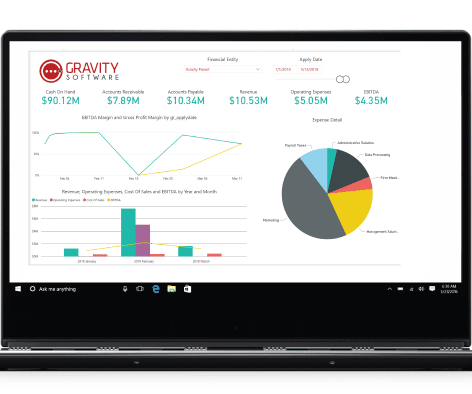
    Gravity Software financial dashboard showing real-time business insights

    Gravity Software is cloud-based accounting and business management software built natively on Microsoft Power Platform. With Microsoft Dataverse as its underlying data platform, Gravity brings financial and operational information together in a connected environment designed for growing and multi-entity organizations.

    Because Gravity is built on Microsoft technology, finance teams can extend accounting beyond traditional financial management. Microsoft Power BI provides advanced reporting and analytics, Power Automate helps automate accounting and business workflows, and Microsoft 365 connects financial information with familiar applications such as Outlook, Teams, Excel and Word. Microsoft 365 Copilot further extends these capabilities by allowing authorized users to interact with Gravity accounting data and supported workflows using natural language.

    This Microsoft foundation gives organizations a flexible, scalable platform for managing accounting, reporting, automation and connected business processes without relying on disconnected systems or separate accounting databases.

  • Why choose Gravity Software on Microsoft Power Platform?
  • Why choose Gravity Software on Microsoft Power Platform?

    Cloud accounting built on Microsoft Power Platform

    Gravity Software combines sophisticated accounting and financial management with the flexibility, security and extensibility of Microsoft technology. Instead of relying on a standalone accounting system surrounded by disconnected applications and data, organizations can connect accounting with reporting, automation, collaboration and AI within a broader Microsoft ecosystem.

    Built for the cloud and ready to scale

    Gravity Software is cloud-native, with Microsoft Dataverse providing a secure, scalable data foundation. As organizations grow, they can add users, entities and business processes without maintaining on-premises infrastructure or managing separate accounting systems for each company.

    For multi-entity organizations, Gravity provides centralized financial management across companies while maintaining appropriate entity-level access and controls. Finance teams can work with consistent financial data across the organization and gain consolidated visibility without repeatedly moving information between separate company files.

    Extend accounting as your business requirements evolve

    Microsoft Power Platform gives organizations the flexibility to extend Gravity as requirements change. Teams can use Power Automate to automate workflows, Power BI to analyze financial and operational data and Power Apps to extend business processes without building disconnected systems around the accounting platform.

    Organizations can also connect accounting with Microsoft 365, Dynamics 365 and Microsoft 365 Copilot, helping finance teams work with financial information across the applications and processes they already use.

  • Benefits of Gravity Software + Microsoft
  • Benefits of Gravity Software + Microsoft

    Gravity Software and Microsoft Power Platform

    Building Gravity Software on Microsoft Power Platform gives growing organizations more than cloud accounting. It provides a connected technology foundation that brings financial management, business data, reporting, workflow automation, AI and familiar Microsoft applications together.

    As your organization grows and requirements change, you don't necessarily have to keep adding disconnected applications, spreadsheets and manual processes. Gravity's Microsoft foundation gives you the flexibility to extend accounting and connected business processes as your needs evolve.


    Customize and extend business processes

    Organizations can configure Gravity to support their financial and operational requirements using Microsoft Power Platform. Power Apps and other low-code capabilities can extend business processes, while configurable fields, workflows and applications help organizations adapt the system as requirements change without creating a collection of disconnected solutions.

    Automate workflows across the business

    With Microsoft Power Automate, organizations can support accounting automation and automate processes that extend beyond accounting, including approvals, notifications and other repetitive workflows. This helps finance teams reduce manual steps while connecting financial processes with other areas of the business.

    Turn accounting data into actionable insights

    Microsoft Power BI connects financial and operational information with interactive dashboards, analytics and reporting. Finance teams and business leaders can analyze performance, identify trends and gain greater visibility across entities without relying solely on static financial reports.

    Work within the Microsoft ecosystem

    Gravity connects accounting with Microsoft technologies organizations may already use, including Microsoft 365, Dynamics 365 CRM, Power BI and Power Automate. This connected environment helps organizations bring financial information into broader business processes instead of treating accounting as an isolated system.

    Build on Microsoft cloud technology

    Gravity Software combines Microsoft cloud technology with role-based and entity-level security to help organizations control access to financial information and functionality. Users can be given access based on their responsibilities and the entities they are authorized to work with, helping organizations protect sensitive financial information as they grow.

    Gravity's Microsoft foundation also supports security capabilities such as identity management and access controls while allowing organizations to maintain appropriate permissions across accounting, reporting, automation and connected Microsoft applications.

    Extend accounting with AI and Microsoft 365 Copilot

    Microsoft 365 Copilot extends Gravity's Microsoft foundation by helping authorized users access accounting information and complete supported accounting tasks from familiar Microsoft applications. Finance teams can use natural language to work with Gravity data in applications such as Outlook, Teams, Excel and Word, extending the role of AI in accounting while maintaining existing role-based permissions.


  • Core Microsoft features and integrations
  • Core Microsoft features and integrations

    Cloud icon representing Microsoft integrations

    Gravity Software extends accounting and financial management with Microsoft technologies that support reporting, workflow automation, collaboration and connected business processes. Organizations can use the capabilities they need while keeping financial information connected to the broader Microsoft ecosystem.

    Key features of Gravity Software on Microsoft Power Platform

    Microsoft 365
    Connect Gravity with familiar Microsoft 365 applications such as Outlook, Teams, Excel and Word, helping finance teams access and work with accounting information within everyday business workflows.
    Microsoft Power BI
    Turn financial and operational data into interactive dashboards and analytics. Power BI helps finance teams and business leaders monitor performance, analyze trends and gain visibility across companies and dimensions.
    Microsoft Power Automate
    Automate approvals, notifications and other accounting and business workflows using Microsoft's low-code automation capabilities. Power Automate helps reduce repetitive manual processes and connect financial workflows with other areas of the organization.
    Microsoft 365 Copilot
    Use natural language to securely access Gravity accounting information and help complete supported accounting tasks from Microsoft applications. Copilot extends Gravity's Microsoft foundation by bringing financial information into the applications where users are already working.
    Dynamics 365 CRM
    Connect Gravity financial information with Dynamics 365 CRM to help reduce disconnected data and improve visibility between sales, customer relationships and accounting.
    Microsoft Power Apps
    Extend business processes with low-code applications built on Microsoft Power Platform. Power Apps gives organizations additional flexibility to address evolving requirements without creating another disconnected technology environment.
  • See Gravity Software in action
  • See Gravity Software in action

    Watch Gravity Software in action

    See how Gravity Software brings accounting, reporting and business processes together on Microsoft Power Platform. In this 7-minute overview, you'll see how Gravity helps growing and multi-entity organizations centralize financial management, automate workflows and gain greater visibility across their businesses.

    Watch the demo to see Gravity Software's multi-entity accounting, financial reporting, dashboards and connected Microsoft capabilities in action.

    Ready to see how Gravity Software can support your organization's accounting and operational requirements? Schedule a personalized demo.

  • Customer success with Gravity Software
  • Customer success with Gravity Software

    Matt Arnold, Controller and Treasurer at SagamoreHill Broadcasting

    SagamoreHill Broadcasting scales accounting across 25 entities

    SagamoreHill Broadcasting manages 25 entities across 13 television stations. After outgrowing QuickBooks Online, the finance team needed a cloud accounting platform that could simplify multi-entity accounting, streamline intercompany activity, provide real-time consolidated reporting and work with Microsoft 365 tools already in use.

    Gravity Software gave SagamoreHill a centralized accounting environment designed to scale with the organization while connecting with Microsoft technologies such as Power BI. The team now manages all 25 entities in one system, reducing manual spreadsheets and duplicate entry while saving time on reconciliations and consolidations.

    “Gravity Software gives us the scalability and automation we need to keep up with our growth and complexity. It’s a system built for organizations like ours.”

    Matt Arnold, Controller/Treasurer, SagamoreHill Broadcasting

    Read the SagamoreHill Broadcasting customer story

  • Explore more accounting and Microsoft technology resources
  • Explore more accounting and Microsoft technology resources

    G2 Users Love Us badge highlighting Gravity Software's customer satisfaction on Microsoft Power Platform

    Modernizing accounting involves more than moving financial data to the cloud. Growing organizations need to consider how their accounting technology supports connected data, multi-entity financial management, reporting, workflow automation, AI and the applications their teams use every day.

    Explore these resources to learn more about modern accounting technology, including AI for accounting, multi-entity financial management, improving the month-end close and moving beyond legacy or entry-level accounting systems as your organization grows.

    AI Accounting
    See how AI can help finance teams reduce manual work, access financial information faster and improve accounting workflows. Learn how Gravity Software uses Microsoft AI capabilities to extend accounting, reporting and automation.
    Multi-Entity Growth
    Learn the signs that your organization may be outgrowing its current accounting system, from time-consuming intercompany balancing and financial consolidation to manual processes and limited financial visibility. Explore when multi-entity accounting software may be the next step for supporting continued growth.
    Legacy Accounting
    Learn where legacy accounting software can create challenges as organizations grow and financial requirements become more complex. Explore the pros and cons of legacy systems and what to consider when evaluating modern cloud accounting alternatives.
    Month-End Close
    Explore ways finance teams can improve the month-end close by reducing manual processes, centralizing financial information and automating repetitive accounting workflows. See how modern accounting technology can provide greater visibility throughout the close process.
    Outgrowing QuickBooks Desktop
    Learn how growing organizations can recognize when QuickBooks Desktop is no longer keeping pace with multi-entity accounting, reporting and operational requirements. Explore what to consider when evaluating a more scalable cloud accounting platform.
    ACCOUNTING TRENDS
    Explore the accounting technology trends shaping how finance teams work, including cloud technology, automation, AI and advanced financial reporting. Learn what these developments can mean for organizations evaluating their next accounting platform.
  • Frequently asked questions
  • Frequently asked questions

    Customer support representative wearing a headset

    Learn more about how Gravity Software uses Microsoft Power Platform to support cloud accounting, multi-entity financial management, reporting, workflow automation, Microsoft 365 and AI. These frequently asked questions explain how Microsoft technology helps growing organizations connect financial data, automate processes and extend their accounting capabilities as their needs evolve.

    arrow

    What is Microsoft Power Platform, and how does it support accounting?

    Microsoft Power Platform includes technologies such as Power BI, Power Apps and Power Automate that help organizations analyze data, automate workflows and extend business processes. Gravity uses these Microsoft capabilities to connect accounting with reporting, automation and other business applications.

    Is Gravity Software a cloud accounting solution?

    Yes. Gravity Software is a cloud-based accounting and business management platform designed for growing and multi-entity organizations. Finance teams can securely access financial information, manage multiple entities and support connected business processes without maintaining traditional on-premises accounting software.

    How does Gravity Software support multi-entity accounting?

    Gravity Software enables organizations to manage multiple companies or entities within a single database. Finance teams can manage entity-level financial information, automate intercompany transactions, create consolidated financial reports and control access to information based on user responsibilities and authorized entities.

    How does Microsoft Power Automate work with Gravity Software?

    Microsoft Power Automate can help organizations automate accounting and business workflows such as approvals, notifications and other repetitive processes. Organizations can extend these workflows beyond the accounting system, connecting financial processes with other applications and business activities.

    Does Gravity Software work with Microsoft 365?

    Yes. Gravity Software works with familiar Microsoft 365 applications such as Outlook, Teams, Excel and Word. This connection helps organizations bring accounting information into the applications employees already use for communication, collaboration and analysis.

    How does Microsoft Power BI work with Gravity Software?

    Microsoft Power BI enables organizations to analyze Gravity financial and operational information through interactive dashboards, reports and visualizations. Finance and leadership teams can use Power BI to monitor performance, analyze trends and gain visibility across companies, departments and other business dimensions.

    Can Microsoft 365 Copilot work with Gravity Software accounting data?

    Yes. Microsoft 365 Copilot can help authorized users interact with Gravity accounting information using natural language from familiar Microsoft applications. Users can retrieve financial information, analyze data and complete supported accounting tasks while maintaining appropriate permissions and review processes.

    How does Gravity Software help protect financial information?

    Gravity Software combines Microsoft cloud technology with role-based and entity-level security. Organizations can control which financial information and functionality users can access based on their responsibilities and the entities they are authorized to work with.

    What industries use Gravity Software?

    Gravity Software is designed for growing organizations with sophisticated accounting and financial management requirements across a range of industries. This includes family offices, franchises, healthcare organizations, holding companies, nonprofits, private equity firms, professional services organizations, real estate and investment firms, renewable energy organizations and other multi-entity businesses.

    What makes Gravity Software different from traditional ERP systems?

    Gravity Software combines sophisticated accounting and financial management with connected operational capabilities on Microsoft Power Platform. Compared with traditional ERP systems, Gravity helps organizations manage multi-entity accounting, financial reporting, workflow automation and other business processes while extending accounting with Microsoft technologies such as Power BI, Power Automate, Microsoft 365 and Copilot.

    How can I see Gravity Software and Microsoft Power Platform in action?

    Schedule a personalized demo to see how Gravity Software supports multi-entity accounting, financial reporting, workflow automation and connected Microsoft capabilities for your organization.

    See what Gravity Software can do for your organization

    See how Gravity Software can help simplify multi-entity accounting, automate financial processes and provide greater visibility across your business. Schedule a personalized demo to explore how Gravity can support your accounting requirements while extending the Microsoft technology your organization already uses.

    schedule a demo with Gravity Software