Healthcare accounting software for multi-entity organizations 

schedule a demo with Gravity Software
x

See how Gravity compares to leading cloud accounting solutions. Request a demo.

Streamline multi-entity healthcare accounting, automate financial consolidations, and gain real-time visibility across entities and locations with Gravity Software's cloud-based accounting solution.

  • Financial management for complex healthcare organizations
  • Financial management for complex healthcare organizations

    Stethoscope icon representing healthcare financial management for multi-entity organizations

    As healthcare organizations expand through new locations, acquisitions, and affiliated practices, financial management becomes more complex. Separate accounting systems, manual intercompany transactions, and disconnected reporting can make it difficult for finance teams to maintain control and provide timely financial information.

    Gravity Software brings multi-entity financial management into one accounting database, helping healthcare CFOs and controllers spend less time managing accounting complexity and more time supporting organizational decisions.

    See how Gravity Software can simplify financial management across your healthcare organization. Schedule a demo.

  • Challenges in healthcare financial management
  • Challenges in healthcare financial management

    Head with gears icon representing challenges in healthcare financial management

    Healthcare organizations often face financial and operational challenges as they expand across multiple entities, locations, and service lines. Common challenges include:

    • Managing multiple entities and locations: Maintaining accurate financial records across clinics, practices, departments, and affiliated organizations.
    • Complex intercompany accounting: Tracking shared expenses, allocations, and due-to/due-from transactions across healthcare entities.
    • Time-consuming financial consolidations: Combining financial information from multiple entities, accounting systems, and spreadsheets.
    • Limited financial visibility: Accessing timely, accurate reporting by entity, location, department, provider, or service line.
    • Financial controls and compliance: Maintaining audit trails, approval processes, role-based access, and appropriate safeguards for financial information.
    • Scaling financial operations: Supporting acquisitions, new locations, and organizational growth without adding unnecessary administrative work.
  • How Gravity Software supports healthcare organizations
  • How Gravity Software supports healthcare organizations

    Gravity Software logo for healthcare accounting solutions.

    Gravity Software provides cloud-based multi-entity accounting software that helps healthcare finance teams manage affiliated entities, automate financial processes, and improve consistency, control, and efficiency across their organizations.

    With Gravity Software, healthcare organizations can:

    • Centralize multi-entity accounting: Manage multiple legal entities and locations in one database while maintaining separate financial records, permissions, and controls.
    • Automate intercompany accounting: Simplify due-to/due-from transactions, shared expenses, allocations, and corporate overhead across healthcare entities.
    • Streamline financial consolidations: Consolidate financial results across entities without relying on separate accounting databases or manual spreadsheets.
    • Improve financial reporting: Analyze financial performance by entity, clinic, location, department, provider, program, or service line using financial dimensions.
    • Automate accounts payable: Reduce manual invoice entry and streamline invoice processing, approvals, and payment workflows.
    • Connect healthcare systems: Exchange financial information with EHR, EMR, billing, payroll, and other operational systems through data imports, Gravity's open API, and supported integration tools.
    • Strengthen financial controls: Maintain audit trails, role-based permissions, approval records, and entity-level security to support financial oversight.
  • Benefits of multi-entity healthcare accounting software
  • Benefits of multi-entity healthcare accounting software

    Buildings with magnifying glass and dollar sign representing benefits of multi-entity healthcare accounting software

    For healthcare CFOs and controllers, the value of modern accounting software extends beyond processing transactions. The right financial foundation helps teams close faster, improve oversight, and support confident decisions as their organizations grow.

    Faster financial close

    Reduce time spent on month-end closing by simplifying intercompany transactions, reconciliations, allocations, and financial consolidations across healthcare entities.

    More accurate financial reporting

    Improve reporting consistency and accuracy with centralized financial data, standardized accounting processes, and consolidated reporting across entities and locations.

    Greater financial visibility

    Give healthcare CFOs, controllers, and leadership teams timely insight into financial performance across clinics, practices, departments, and service lines.

    Increased accounting efficiency

    Reduce manual data entry, repetitive accounting tasks, and spreadsheet-based processes so finance teams can spend more time on analysis and strategic planning.

    Easier growth and acquisitions

    Support new healthcare entities, practices, and locations within a single accounting database without creating separate accounting systems or increasingly complex reporting processes.

    Stronger financial controls

    Maintain consistent financial oversight with role-based security, approval workflows, audit trails, and entity-level controls across the organization.

  • Designed for multi-entity healthcare organizations
  • Designed for multi-entity healthcare organizations

    Multi-entity buildings icon representing accounting for multi-entity healthcare organizations

    From independent medical groups to private equity-backed healthcare networks, different organizational structures create different financial management demands. Gravity Software supports healthcare organizations that need to maintain financial control while operating across multiple legal entities, practices, and locations.

    Gravity Software supports:

    • Multi-location medical practices: Manage financial operations across multiple clinics, offices, and legal entities while maintaining centralized reporting and financial oversight.
    • Private equity-backed healthcare groups: Support acquisitions, healthcare roll-ups, intercompany transactions, and consolidated financial reporting as organizations expand.
    • Specialty healthcare providers: Simplify accounting across dental practices, behavioral health organizations, physical therapy clinics, eye care groups, and other specialty providers.
    • Healthcare holding companies and management organizations: Manage multiple affiliated businesses, shared expenses, allocations, and financial reporting within one accounting database.
    • Growing healthcare organizations: Transition from QuickBooks or disconnected accounting systems to a scalable solution that supports increasing financial complexity.
  • Built on the Microsoft Power Platform
  • Built on the Microsoft Power Platform

    Microsoft Power Platform logo representing Gravity Software's Microsoft-based accounting platform

    Gravity Software leverages the Microsoft Power Platform to provide a flexible foundation for financial management.

    Healthcare finance teams can work with familiar Microsoft technologies, including Microsoft 365, Power BI, and Power Automate. These capabilities provide options for building custom reporting solutions, extending workflows, and connecting financial information with other business applications.

    Microsoft 365 Copilot capabilities also help authorized users interact with Gravity financial information using natural language.

  • Improved financial visibility and reporting
  • Improved financial visibility and reporting

    Bar chart icon representing improved financial visibility and reporting

    Healthcare finance leaders need more than consolidated financial statements. They need to understand performance across individual practices, departments, providers, and service lines to evaluate costs, monitor budgets, and identify opportunities for improvement.

    With Gravity Software, healthcare organizations can:

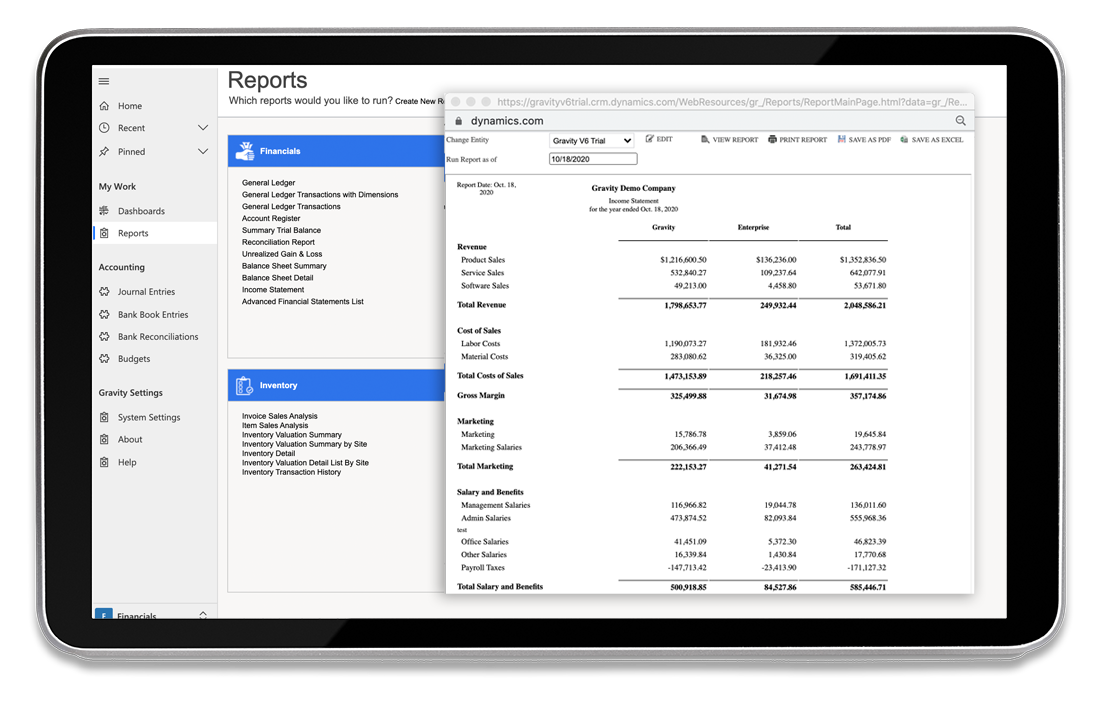
    • Consolidate financial reporting: Generate consolidated financial statements across multiple healthcare entities while maintaining visibility into individual organizations.
    • Analyze financial performance: Report by entity, clinic, location, department, provider, program, or service line using financial dimensions.
    • Simplify month-end reporting: Reduce manual consolidations, reconciliations, and spreadsheet-based reporting processes.
    • Improve budgeting and financial planning: Compare actual financial results against budgets to identify trends, variances, and opportunities for improvement.
    • Create custom financial reports: Use Gravity's Advanced Financial Reporting capabilities to develop financial statements tailored to organizational reporting needs.
    • Extend reporting with Power BI: Build custom dashboards and visualizations using Gravity financial data alongside other business information.
    Gravity Software consolidated financial report showing income statement data across multiple entities
  • Supporting compliance and data security
  • Supporting compliance and data security

    Padlock icon representing compliance and data security for healthcare financial systems

    Healthcare organizations need strong financial controls, secure access to accounting information, and reliable audit trails to maintain accountability across multiple entities, practices, and locations. Gravity Software helps finance teams strengthen financial oversight while supporting efficient accounting operations.

    Gravity Software provides:

    • Role-based security: Control access to financial information based on user responsibilities and permissions.
    • Entity-level security: Restrict access to specific healthcare entities while maintaining centralized financial management.
    • Audit trails: Track financial transactions and changes to support accountability, transparency, and audit readiness.
    • Approval workflows: Establish consistent review and approval processes for financial transactions and accounts payable.
    • Supporting documentation: Attach invoices, receipts, and other financial records to transactions for easier review and auditing.
    • Microsoft security capabilities: Leverage Microsoft Entra ID authentication and supported Microsoft security controls to help protect access to financial information.

    Healthcare organizations should evaluate accounting software security controls alongside their own HIPAA obligations, data-handling policies, and regulatory requirements. Gravity's financial controls can support internal compliance processes, but HIPAA compliance depends on the organization's overall systems, configurations, and handling of protected health information.

    Learn more about Gravity Software's security capabilities.

  • Client spotlight: Dr. Tavel Family Eye Care
  • Client spotlight: Dr. Tavel Family Eye Care

    Tera Carpenter, Vice President of Finance & HR at Dr. Tavel Family Eye Care.

    As Dr. Tavel Family Eye Care expanded across multiple locations and legal entities, its legacy Sage 100 accounting system made it increasingly difficult to manage financial operations efficiently. The organization needed a modern, cloud-based accounting solution to streamline processes, improve financial reporting, and gain greater visibility across its growing healthcare business.

    With Gravity Software, Dr. Tavel Family Eye Care was able to:

    • Simplify multi-entity accounting: Manage financial operations across 10 entities and 24 locations while maintaining centralized financial oversight.
    • Streamline month-end close: Reduce time spent on bank reconciliations, routine accounting processes, and financial closing activities.
    • Focus on financial analysis: Free up time for budgeting, financial analysis, and strategic recommendations that support organizational growth.

    “With all the time we’re saving on bank reconciliation, month-end close, and other routine tasks, we can do more financial analysis, budgeting, and providing valuable feedback to the company on strategic direction.”

    — Tera Carpenter, VP of Finance and HR, Dr. Tavel Family Eye Care

    Read the Dr. Tavel Family Eye Care customer story.

  • Additional resources for healthcare organizations
  • Additional resources for healthcare organizations

    G2 'Users Love Us' badge, recognizing Gravity Software for its high customer satisfaction with an average rating of 4.0 stars or higher

    Explore resources to help healthcare finance teams evaluate accounting software, simplify multi-entity financial management, improve reporting, and automate accounting processes across multiple practices, locations, and legal entities.

    Multi-entity accounting guide

    Learn how multi-entity accounting software helps growing organizations manage multiple businesses in one database, automate intercompany transactions, simplify consolidations, and improve financial visibility.

    Multi-location healthcare accounting

    Explore how healthcare organizations can simplify accounting across multiple practices and locations, centralize financial reporting, and improve visibility into organizational performance.

    Healthcare accounting best practices

    Discover accounting best practices for healthcare organizations, including financial controls, efficient workflows, accurate reporting, and strategies for managing growth.

    Healthcare financial reporting

    Learn how healthcare finance teams can improve reporting accuracy, streamline financial consolidations, and gain better visibility across entities, clinics, departments, and service lines.

    Consolidated financial reporting

    Explore how multi-entity organizations can simplify financial consolidation, reduce manual reporting, and gain a clearer view of financial performance across their businesses.

    AI and automation in healthcare accounting

    Discover how AI-powered tools and accounting automation can help healthcare finance teams reduce manual work, streamline accounts payable, and improve financial reporting efficiency.

    Microsoft 365 Copilot for accounting

    Learn how Microsoft 365 Copilot capabilities work with Gravity Software to help authorized finance users interact with financial information using natural language and gain insights within their Microsoft environment.

    Accounts payable automation

    Discover how healthcare finance teams can reduce manual invoice entry, streamline approval workflows, and improve accounts payable efficiency across multiple entities and locations.

    Accounting data security

    Explore accounting security best practices, including role-based access, audit trails, encryption, and financial controls that help healthcare organizations protect sensitive financial information.

  • Frequently asked questions
  • Frequently asked questions

    Gravity Software salesperson icon answering healthcare accounting questions

    Healthcare organizations evaluating accounting software often have questions about functionality, scalability, and fit. The following answers address common considerations to help guide informed decision making.

    Arrow-new

    What is healthcare accounting software?

    Healthcare accounting software helps healthcare organizations manage financial operations across entities, locations, clinics, departments, and service lines. It can support financial reporting, accounts payable, budgeting, financial controls, and other accounting processes while helping finance teams manage the complexity of healthcare operations and organizational growth.

    What is the best accounting software for healthcare organizations?

    The best accounting software for a healthcare organization depends on its size, structure, and financial complexity. Organizations managing multiple entities or locations should look for software that supports multi-entity accounting, automated consolidations, reporting across locations and entities, strong financial controls, and flexible options for connecting with other business systems.

    Do healthcare organizations need multi-entity accounting software?

    Healthcare organizations with multiple legal entities, locations, clinics, or affiliated businesses can benefit from multi-entity accounting software. It allows finance teams to manage entities within one accounting environment, automate intercompany transactions and consolidations, and report across the organization without relying on separate company files and manual spreadsheets.

    What features should healthcare accounting software include?

    Healthcare organizations should look for accounting software that supports:

    • Multi-entity and multi-location accounting
    • Automated intercompany transactions and consolidations
    • Reporting by entity, location, clinic, provider, department, and other financial dimensions
    • Accounts payable automation and approval workflows
    • Role-based security, audit trails, and financial controls
    • Flexible data import tools and an open API for connecting accounting with EHR, EMR, billing, payroll, and other operational systems
    • Scalability to support additional entities and locations as the organization grows

    When should a healthcare organization upgrade from QuickBooks or basic accounting tools?

    Healthcare organizations may outgrow QuickBooks or other basic accounting tools when they add entities or locations, require consolidated financial reporting, spend significant time on intercompany accounting and reconciliations, or rely heavily on spreadsheets and manual processes. Moving to a multi-entity accounting platform can help simplify accounting across entities and locations and support continued growth.

    How can healthcare organizations improve financial reporting?

    Healthcare organizations can improve financial reporting by centralizing financial data, standardizing accounting structures, automating consolidations and intercompany processes, and reporting consistently across entities and locations. Modern accounting platforms can also provide reporting by clinic, provider, department, program, and service line, giving finance and leadership teams greater visibility into organizational performance.

    Is healthcare accounting software required to be HIPAA compliant?

    HIPAA requirements depend on how healthcare accounting software is used and whether it creates, receives, maintains, or transmits protected health information (PHI). Accounting systems used exclusively for financial information may not require the same safeguards as systems handling PHI.

    Healthcare organizations should evaluate their accounting software, data-handling practices, access controls, and vendor agreements to determine which HIPAA requirements apply. Security features alone do not establish HIPAA compliance.

    How does modern accounting software help growing healthcare organizations?

    Modern accounting software helps growing healthcare organizations manage increasing financial complexity, automate repetitive accounting processes, consolidate financial reporting, and manage additional entities and locations as the organization expands. Multi-entity platforms can also reduce the accounting complexity associated with acquisitions, new locations, and healthcare roll-ups.

    Why is Gravity Software a good fit for multi-entity healthcare organizations?

    Gravity Software helps healthcare organizations manage multiple legal entities, clinics, and locations within one accounting database. With automated intercompany accounting, financial consolidations, reporting by entity and location, and streamlined financial workflows, Gravity helps finance teams reduce manual processes and gain greater visibility into financial performance. Its multi-entity architecture supports healthcare organizations as they expand, acquire practices, and manage increasingly complex financial operations.

    How does Gravity Software support healthcare organizations?

    Gravity Software supports healthcare finance teams with accounts payable automation, approval workflows, budgeting, financial reporting, and tools for managing day-to-day accounting operations. Flexible data imports and an open API provide options for connecting financial information with EHR, EMR, billing, payroll, and other operational systems, depending on the organization's integration requirements.

    See how Gravity simplifies multi-entity healthcare accounting

    Ready to see if Gravity Software is the right fit for your healthcare organization? Schedule a personalized demo to discuss your accounting challenges, explore Gravity's capabilities, and see how the solution can support your organization's financial management needs.

    schedule a demo with Gravity Software