
Multi-entity accounting solutions for growing organizations
Most companies don’t begin their search with the phrase “multi-entity accounting solutions.”
They begin with friction.
Month-end stretches longer each quarter. Consolidations rely on spreadsheets. Intercompany entries multiply. Reporting requests from leadership take too long to answer.
At first, it feels like a workload issue.
Then it becomes clear: it’s an infrastructure issue.
When organizations grow into multiple entities — whether through expansion, acquisitions, new locations, investment structures, or legal separation — accounting structure has to evolve with them. If it doesn’t, complexity compounds quietly in the background.
That’s when multi-entity accounting stops being a feature requirement and becomes a structural decision.
What a true multi-entity accounting solution looks like
A multi-entity accounting solution is not simply accounting software that allows you to create more than one company.
It is a system designed around consolidation, intercompany automation, and shared structure from the ground up.
When multi-entity functionality is layered onto a single-entity foundation, teams end up managing workarounds:
-
duplicating vendor records
-
maintaining separate charts of accounts
-
manually balancing due-to and due-from
-
exporting reports for consolidation
A true solution is built differently.
It supports:
-
A unified database structure across entities
-
Controlled sharing of master data
-
Automated intercompany entries
-
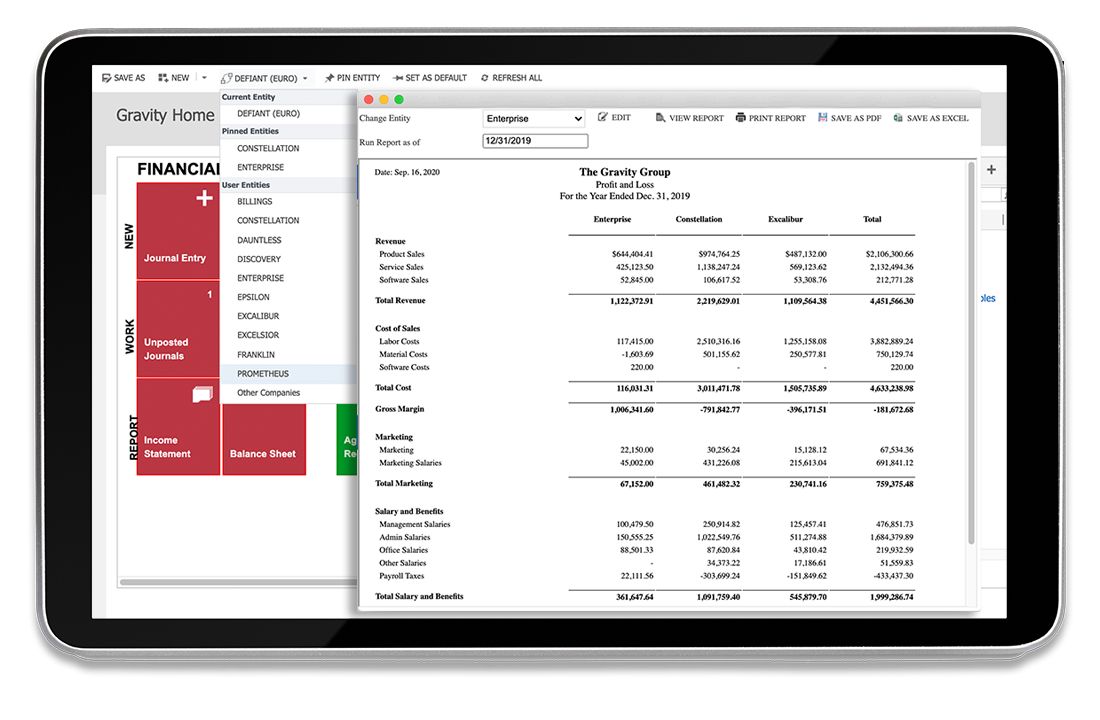
Consolidated reporting with drill-down
-
Dimensional reporting without overloading the chart of accounts
-
Entity-level security and role controls
-
Scalability as entity count grows
For a deeper look at database architecture, read one database for multi-entity accounting.
And for how structure impacts team efficiency, see empower your multi-entity accounting team with the right software.
Why growing companies outgrow entry-level accounting
Entry-level accounting systems are built for simplicity. They work well when there is:
-
one operating entity
-
limited intercompany activity
-
straightforward reporting requirements
But growth changes the model.
When organizations expand into subsidiaries, holding structures, SPVs, portfolio entities, or multi-location operations, structural strain appears.
Common friction points include:
-
Separate databases for each entity
-
Manual consolidation processes
-
Inconsistent charts of accounts
-
Repeated vendor maintenance
-
Increased month-end workload
This is where many organizations realize that tools designed for simplicity aren’t designed for scale.
If you are seeing these patterns in QuickBooks, start here: QuickBooks wasn’t designed for multi-entity complexity.
And if you’re unsure whether you’ve reached the tipping point, review signs it’s time to upgrade.
What to evaluate in multi-entity accounting solutions
When evaluating multi-entity accounting solutions, the most important question is not “What features does it have?”
It is: “What work will this eliminate?”
A strong solution should reduce manual processes and remove structural duplication.
Evaluate these areas carefully:
Database structure
Are all entities managed within one system, or are you stitching together multiple databases?
Intercompany automation
Does the system automatically generate and balance due-to/due-from entries?
Consolidated reporting
Can you generate consolidated financial statements instantly—with drill-down to the entity and transaction level?
Dimensions
Can you report by property, clinic, program, location, investor, or division without inflating your chart of accounts?
For organizations with shared services, allocations can be just as important as consolidation. With statistical accounting, you can automate driver-based allocations across entities instead of relying on manual journal entries. Learn more about statistical accounting and allocations.
Controls and security
Can permissions be managed at the entity level?
Workflow automation
Are approvals, batch processing, and reconciliations streamlined?
If budget is part of the decision, review Gravity Software pricing as you estimate scope and ROI.
If close time is one of your primary concerns, explore reduce month-end close time.
And if AI-assisted workflows are part of your evaluation, review AI tools that reduce manual accounting work.
How consolidation and intercompany automation change the close
In multi-entity environments, close efficiency is directly tied to structure.
Manual intercompany entries consume time. Spreadsheet consolidation introduces risk. Rebuilding financials each month delays reporting.
When consolidation and intercompany are automated, the close changes fundamentally:
-
Fewer journal entries
-
Less duplication
-
Faster reconciliation
-
Real-time consolidated visibility
-
Reduced spreadsheet dependency
The accounting team spends less time maintaining structure and more time analyzing performance.
This is where multi-entity accounting solutions deliver measurable operational impact.
How reporting needs evolve as your entity count grows
The reporting requirements of a five-entity organization are very different from those of a 50-entity group.
As entity count increases, leadership expects:
-
Consolidated financial statements
-
Entity-by-entity comparisons
-
Dimensional reporting across locations or divisions
-
Investor or ownership visibility
-
Drill-down access without rebuilding reports
If reporting relies on exported spreadsheets, confidence declines as complexity grows.
A scalable multi-entity accounting solution ensures reporting evolves with structure — not against it.
How to choose the right solution without overbuying
When complexity increases, many organizations assume they need a full ERP.
In some cases, that’s appropriate.
But many growing companies primarily need:
-
Consolidation
-
Intercompany automation
-
Reporting flexibility
-
Security controls
-
Scalability
Not dozens of additional modules.
Before committing to enterprise-level complexity, determine whether your structural needs can be solved with a purpose-built multi-entity accounting solution.
If Business Central is part of your evaluation, compare approaches in Business Central vs Gravity.
Or explore an alternative to Business Central.
Next steps for evaluating multi-entity accounting solutions
If you are researching multi-entity accounting solutions, focus on architecture first.
The right foundation reduces manual effort, improves visibility, and supports growth without constant restructuring.
Managing multiple entities should not require constant spreadsheet consolidation or manual intercompany balancing.
If your organization has outgrown entry-level accounting software, it may be time to evaluate a purpose-built multi-entity solution.
Schedule a demo to see how Gravity Software simplifies consolidation, automates intercompany, and supports scalable reporting for growing organizations.
Gravity Software
Better. Smarter. Accounting.