
Managing multiple companies can create unnecessary accounting work when each entity operates in a separate company file or database. Finance teams may find themselves switching between companies, maintaining duplicate vendor and customer records, entering corresponding intercompany transactions, allocating shared expenses, and combining financial information in spreadsheets.
Multi-company accounting software is designed to reduce that complexity by helping organizations manage multiple legal entities within a centralized accounting environment while maintaining the separate financial records each company requires.
The benefits extend beyond saving time. A centralized multi-company accounting structure can help organizations automate intercompany accounting, simplify consolidated financial reporting, allocate shared expenses, improve financial controls, and gain greater visibility across the organization.
As the number of entities grows, these efficiencies become increasingly important. Understanding the benefits of multi-company accounting software can help finance leaders determine whether their current accounting system is still supporting the way their organization operates.
Why multi-company accounting architecture matters
The way accounting software structures multiple companies can have a significant impact on the amount of work required to manage them.
Some accounting systems allow organizations to maintain multiple companies but keep each company in a separate file or database. Finance teams may still need to switch between companies to enter transactions, update financial information, reconcile activity, and prepare reports.
As the number of entities grows, those separate environments can create more repetitive work and make organization-wide accounting processes more difficult to manage.
Multi-company accounting software designed around a centralized accounting environment allows finance teams to manage individual legal entities while connecting the financial processes and information that need to work across the organization.
This architecture can provide the foundation for automating intercompany accounting, sharing appropriate financial structures, allocating expenses across entities, consolidating financial reporting, and gaining organization-wide financial visibility.
1. Reduce repetitive accounting across entities
When companies are maintained separately, finance teams often repeat the same accounting tasks across multiple entities. Vendor and customer information may need to be entered or updated several times, transactions may need to be recreated, and users may spend significant time switching between company files or databases.
Multi-company accounting software can reduce this repetitive work by allowing appropriate financial information and processes to be shared across entities. Vendors, customers, charts of accounts, and other financial structures can be maintained more consistently without requiring the same changes to be made separately for every company.
Reducing duplicate data entry not only saves time but can also improve consistency as the organization adds more entities.
2. Simplify intercompany accounting
Transactions between related companies can create significant accounting work when each entity is managed separately.
One company may pay an expense on behalf of another, provide services to a subsidiary, transfer funds, or conduct other intercompany activity. Finance teams may then need to manually record corresponding entries in each company and reconcile due-to and due-from balances.
Multi-company accounting software can automate corresponding intercompany entries, helping keep both sides of the transaction aligned. It can also support intercompany eliminations when preparing consolidated financial statements.
As intercompany activity increases, this automation can substantially reduce repetitive journal entries and reconciliation work.
3. Allocate shared expenses across multiple companies
Organizations with multiple entities frequently incur expenses that need to be distributed across companies. Payroll, insurance, technology, professional services, rent, administrative costs, and other overhead may benefit several entities.
Without multi-entity allocation capabilities, finance teams may calculate the distribution in spreadsheets and create separate journal entries for each company.
Multi-company accounting software can automate shared expense allocations using defined allocation methods. A single expense can be distributed across the appropriate entities while maintaining the accounting records required by each company.
This can make recurring allocations faster, more consistent, and easier to manage as the organization grows.
4. Consolidate financial reporting faster
Finance teams need to understand how individual entities are performing while also seeing the financial position of the organization as a whole.
When companies operate in separate accounting environments, consolidated reporting may require exporting financial information from multiple systems and combining it in spreadsheets or another reporting application.
Multi-company accounting software can simplify this process by supporting financial reporting across selected entities or the entire organization. Finance teams can produce entity-level and consolidated financial statements without repeatedly assembling information from separate company files.
Faster access to consolidated financial information can also give leadership more timely information for decision-making.
5. Improve financial visibility across the organization
Managing multiple companies makes it increasingly important to see financial information across entities without losing the ability to investigate individual-company performance.
Multi-company accounting software can provide organization-wide visibility into financial activity while allowing users to drill into the entities and transactions behind the results.
Finance leaders can compare companies, monitor receivables and payables, identify trends, and evaluate performance across locations, subsidiaries, investments, or other organizational structures.
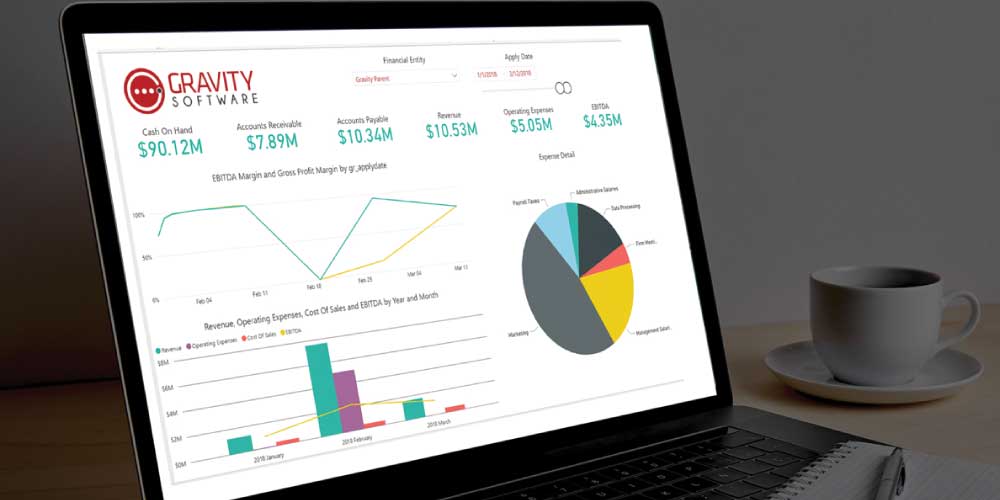
Dashboards and business intelligence can extend this visibility by presenting key financial information in a format that is easier to monitor and analyze.
6. Standardize financial processes and data
As organizations add entities, inconsistencies in financial structures and accounting processes can make reporting and analysis more difficult.
Multi-company accounting software can help organizations standardize appropriate financial structures, including charts of accounts, vendors, customers, dimensions, and reporting practices across entities.
Individual companies can still maintain the accounting information and processes unique to their operations, while the organization establishes enough consistency to simplify accounting and reporting.
Standardization can be particularly valuable when adding newly created or acquired entities.
7. Strengthen financial controls
Growth typically means more companies, more users, and more people interacting with financial information.
Multi-company accounting software can provide role-based and entity-level security that determines which companies and financial information each user can access. Configurable workflows and approvals can also help organizations establish consistent financial processes across entities.
A complete transactional audit trail provides additional visibility into financial activity and changes.
Together, these capabilities can help organizations strengthen internal controls and separation of duties as their financial operations become more complex.
8. Gain more flexible financial reporting with dimensions
Legal entity is only one way a growing organization may need to analyze its financial information.
Finance teams may also want to report by department, location, project, fund, business unit, investment, property, or other business characteristics.
Dimensions provide a flexible way to categorize financial activity without continually expanding the chart of accounts. When dimensions can be used across entities, finance teams can analyze financial information from multiple perspectives at both the individual-company and organization-wide level.
This can make financial reporting more useful as organizational structures and management requirements evolve.
9. Reduce dependence on spreadsheets and manual processes
Spreadsheets remain useful financial tools, but they can become problematic when they are required to connect accounting processes that the underlying system cannot manage across companies.
Manual consolidation, allocation calculations, intercompany reconciliations, and organization-wide reporting can create additional steps outside the accounting system.
Multi-company accounting software can bring more of these processes into the financial environment, using accounting automation to reduce repetitive work and the need to move information between separate company files and spreadsheets.
The result is not necessarily the elimination of spreadsheets. It is reducing their use as a workaround for accounting processes that can be managed more efficiently within the accounting system.
10. Scale accounting as the organization grows
The benefits of multi-company accounting software become increasingly important as organizations add entities.
Processes that are manageable with two or three companies can become significantly more time-consuming when an organization grows to 10, 25, 50, or more entities. Acquisitions can accelerate that complexity by introducing additional companies, users, financial structures, currencies, and reporting requirements.
A scalable multi-company accounting environment should make it easier to incorporate additional entities into existing accounting processes, reporting, security, workflows, and financial structures.
This allows the accounting environment to support organizational growth without requiring finance teams to continually add manual processes simply because the number of companies has increased.

What are the benefits of multi-company accounting software?
Multi-company accounting software can help organizations reduce duplicate data entry, automate intercompany accounting, allocate shared expenses, consolidate financial reporting, strengthen financial controls, and improve visibility across multiple entities.
When companies are managed within a centralized accounting environment, finance teams can spend less time switching between separate company files, reconciling transactions, and assembling information in spreadsheets. This gives them more time to analyze financial performance and support decision-making across the organization.
How Gravity Software supports multi-company accounting
Gravity Software is designed for growing organizations that need to manage multiple companies within a centralized accounting environment. Rather than maintaining separate accounting databases for each entity, finance teams can manage multiple companies in one database while maintaining the financial records and reporting requirements of each legal entity.
Gravity supports multi-entity accounting, automated intercompany transactions, consolidated financial reporting, multi-entity allocations, dimensional reporting, multi-currency accounting, configurable workflows and approvals, and role- and entity-based security.
Built natively on the Microsoft Power Platform, Gravity extends multi-company financial operations with Microsoft technologies including Power BI for business intelligence, Power Automate for workflow automation, Microsoft 365, and Microsoft 365 Copilot.
For organizations that have outgrown separate company files, manual intercompany entries, spreadsheet-based consolidation, or other workarounds, Gravity provides a scalable accounting platform designed to simplify financial management as the organization grows.
Schedule a personalized demo to discuss your multi-company accounting requirements and see how Gravity can support your organization.
Gravity Software
Better. Smarter. Accounting.

Updated September 14, 2026