

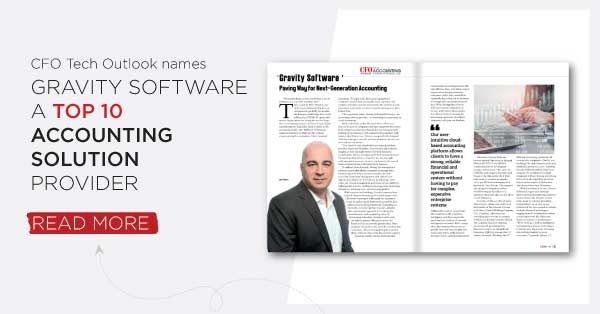
Gravity Software was recognized as a Top 10 Accounting Solution Provider by CFO Tech Outlook in its 2021 Accounting Edition. The recognition highlighted Gravity's approach to helping growing organizations manage increasingly complex accounting requirements without immediately moving to a traditional enterprise resource planning (ERP) system.
As businesses grow, their accounting needs rarely stay simple. Adding companies, locations, departments or new lines of business can create more intercompany transactions, reporting requirements, approval processes and financial data to manage. Finance teams relying on entry-level or legacy accounting systems may find themselves spending more time moving between company files, consolidating information in spreadsheets and building reports manually.
Gravity Software is a cloud-based accounting platform designed to help growing organizations manage these challenges within one connected system.
Accounting software designed for growing organizations
Built on the Microsoft Power Platform, Gravity Software gives finance teams a way to manage multiple companies and financial processes without maintaining separate accounting databases for every entity.
This becomes increasingly important as an organization moves beyond entry-level accounting systems or older legacy accounting software. What may have worked for one company can become more difficult to manage when the business expands to five, 10, 20 or more entities. Separate company files, disconnected processes and limited reporting flexibility can make consolidated reporting more time-consuming and increase reliance on spreadsheets during month-end close.
Gravity brings financial information together so accounting teams can work across entities, automate routine processes and gain greater visibility into the organization as a whole.
Reflecting on the recognition, John Silvani, CEO of Gravity Software, said, “We’re honored to have been recognized by CFO Tech Outlook. Our goal is to help growing organizations simplify multi-entity accounting, automate financial processes and gain better visibility across their businesses through a modern accounting platform built on Microsoft technology.”
Supporting the complexity of multi-entity accounting
For organizations managing multiple legal entities, accounting complexity can increase quickly. Finance teams may need to maintain consistent financial structures, process transactions between related companies, control user access and produce both entity-level and consolidated financial statements.
Gravity's multi-entity accounting capabilities are designed to help finance teams manage these requirements within a centralized system. Instead of logging in and out of separate databases, authorized users can work across multiple entities while maintaining the appropriate financial and security structure for each company.
This connected approach also supports consolidated financial reporting, giving finance leaders greater visibility across the organization without relying as heavily on spreadsheets to bring financial information together.
Using the Microsoft ecosystem to connect accounting and business data
Gravity's foundation on Microsoft technology continues to shape how the platform supports growing organizations today.
Gravity works within the Microsoft ecosystem, with connections to tools businesses already use, including Microsoft 365, Power BI and Microsoft Teams. This helps organizations connect accounting information with familiar productivity, collaboration and business intelligence tools.
Finance teams can also use dimensional reporting to analyze financial information by areas such as department, location or project without continually expanding the chart of accounts.
Automating financial processes as organizations grow
Growth does not only create additional reporting requirements. It can also increase transaction volume and the amount of repetitive work handled by the accounting team.
Automation can help finance teams spend less time on routine processing while maintaining the controls needed as the organization becomes more complex. Gravity includes capabilities for accounts payable automation, bank reconciliation and budgeting, along with workflows that help organizations manage financial processes more efficiently.
Bringing these capabilities together with multi-entity accounting and financial reporting gives growing organizations a foundation that can continue to support them as their accounting requirements evolve.
Recognition that reflects Gravity's approach to accounting software
The 2021 CFO Tech Outlook recognition reflected an approach that remains central to Gravity Software today: give growing organizations sophisticated financial management capabilities without forcing their accounting teams into unnecessary complexity.
For organizations that have outgrown entry-level accounting software or are limited by a legacy accounting system, the goal is not simply to replace one accounting system with another. It is to create a financial foundation that makes it easier to manage multiple entities, automate accounting processes, improve reporting and gain better visibility into the business.
Read the original CFO Tech Outlook article.
See how Gravity Software can support your growing organization
Industry recognition is meaningful, but the real value of accounting technology is how well it supports your organization as financial complexity grows. Gravity Software helps growing businesses manage multiple entities, automate accounting processes, simplify consolidated financial reporting and gain greater visibility across their operations.
If your organization is outgrowing entry-level accounting software, struggling with a legacy accounting system or relying on spreadsheets and manual processes to manage multiple companies, schedule a demo of Gravity Software to see how one connected platform can support your accounting and reporting needs.
Explore more:
Gravity Software
Better. Smarter. Accounting.

Updated on September 25, 2026